
Hard Tech in the Deccan: Inside 247VC’s NexTech Series — Hyderabad
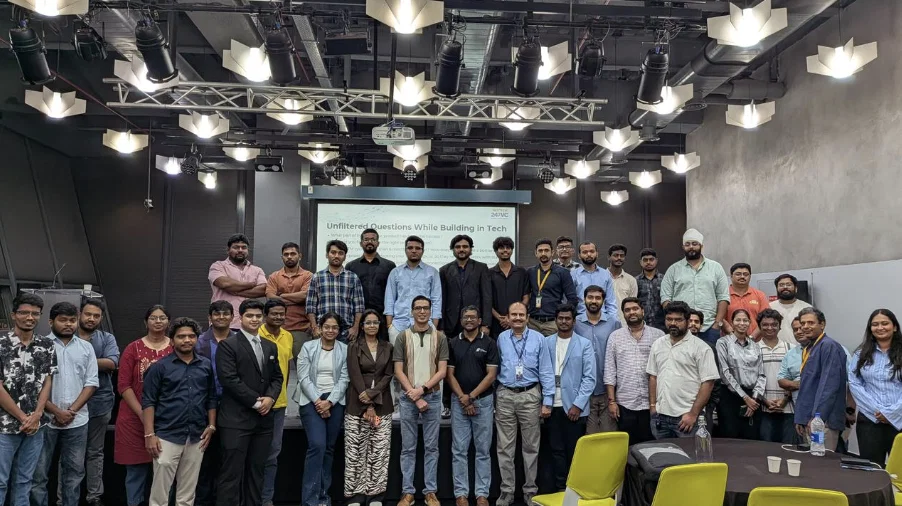
Forty Founders. One Room. Everything on the Table.
The best technology companies are not built in conference halls. They are built in cleanrooms, fabrication labs, testing rigs, and the relentless inner monologue of founders who know exactly what the physics will and will not allow. The people building them rarely end up in the same place at the same time – NexTech Series is here to change that!
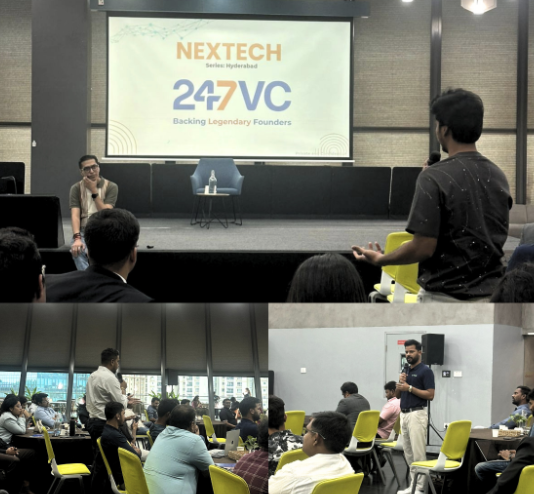
Hyderabad does not need an introduction to deep technology. Genome Valley. DRDO campuses. ISRO facilities. A pharmaceutical industry that manufactures for the world. The infrastructure of serious science has always been here. What has been missing is a room where the next generation of builders can encounter each other — not to pitch, not to panel, but to compare notes, stress-test assumptions, and surface the kind of insight that only comes from another founder who has been in the same trench.
Who Was In The Room
NexTech Hyderabad brought together one of the most technically dense founder cohorts 247VC has assembled. What united them was a shared conviction: the technology itself is the product, and real moats take years of iteration to build.
The companies represented spanned:
Advanced materials and energy storage: nanoscale silicon battery anodes. High-purity graphene membranes for industrial wastewater recovery.Green hydrogen and clean energy: direct seawater electrolysis without desalination or critical electrode materials. A residential solar OS for India’s fragmented rooftop market.
Space and defence: a fully reusable small-satellite launch vehicle. Autonomous spacecraft for in-orbit satellite servicing. V2X communication over the 5.9GHz spectrum for real-time crash prediction.
Medical devices, femtech, and digital health: next-generation smart stents. IoT biosensors for controlled drug delivery. ML-driven reproductive health diagnostics closing India’s 7–10-year diagnosis gap. Home-delivered affordable digital hearing aids. Multimodal AI for operational readiness assessment.
AI in physical industries: quality intelligence for manufacturing MSMEs. AI-powered critical mineral exploration. Edge computer vision built for Indian operating conditions. Video analytics deployed across 15+ countries
.…and many more across deeptech, sustainability, enterprise infrastructure, and beyond.
What Got Covered
The most valuable part of a gathering like this is what happens when founders are in proximity to people who understand the specific texture of their problem, not the category, but the exact failure mode, the exact physics, the exact procurement cycle.
The India Advantage — and the India Constraint. Many companies in this room are building technology that only makes complete sense in India. Products designed for direct seawater rather than purified feedstock. Water purifiers that run without electricity. Hearing care that reaches patients at home. Agricultural AI that functions with fragmented, inconsistent datasets. These are not workarounds, they are design philosophies. Founders building first-principles solutions for India’s constraints are accumulating domestic market depth that is genuinely hard for international entrants to replicate.
The Data Infrastructure Problem. Before AI delivers value, data has to exist at quality and scale. Founders in manufacturing, mineral exploration, and clinical health described the same upstream problem: the training dataset you need does not yet exist in usable form. The companies building proprietary data acquisition infrastructure through hardware sensors, clinical workflow integration, geospatial data pipelines are building moats invisible in a pitch deck and formidable in practice. The AI layer is the application. The data infrastructure is the asset.
Hardware Moats Are Real, and They Take Time. Quantum hardware, silicon photonics, medical devices, battery anodes, reusable launch vehicles — none of these are built in a sprint. Capital requirements are higher. Regulatory pathways are longer. Failure modes are less recoverable. But the moats, when built, are durable in ways software layers rarely are. DeepTech does not move at the speed of hype — it moves at the speed of conviction. Founders in this room are accumulating hard-won technical knowledge that cannot be replicated quickly by any competitor, domestic or foreign.
Regulatory Engagement as Competitive Advantage. For founders in medical devices, quantum sensing, defence, space, and privacy compliance, regulatory navigation is not a box to check — it is part of the product. Companies that engage proactively with DCGI, DRDO, ISRO, or sectoral standards bodies early, that build credibility with regulators before they need approvals — these companies create a barrier to entry that a better-funded competitor cannot simply buy their way around.
The Infrastructure Layer Play. Several companies in the room are not building applications — they are building the operating layer that other products run on. The OS for manufacturing procurement. The compliance engine for the global privacy economy. The AI resolution layer for enterprise HR. Slower to sell, harder to explain in a one-pager, and significantly harder to displace once embedded.