Why We Invested in Dream Aerospace

June 16, 2026

Thrust, Specific Impulse, Payload: Why We Invested in Dream Aerospace

At 247VC, we have spent the last year questioning “Why SpaceTech and Why Now?”. After rigorous internal research, conversations with ex-ISRO scientists, founders of leading global spacetech companies and operators who run large constellations today, we’ve arrived to the conclusion: India is hitting an inflection point where capital, policy and talent are finally aligned to build not just launch vehicles and payloads, but the invisible mobility layer of space.

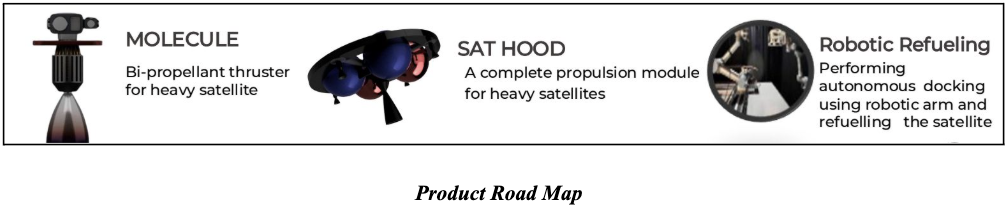
Dream Aerospace is at the forefront of India’s emerging space mobility layer, developing compact, refuelable propulsion systems tailored for CubeSats & SayHoods. As the global demand for small satellites surges – over 11,600 launches expected by 2030 – Dream addresses a critical gap: most propulsion solutions are either bulky, toxic, or require bespoke engineering for each mission. 

Dream is an acronym: D for drones, R for rockets, E for engines, A for aeroplanes, M for missiles. Hari describes it as “the complete aerospace stack, from small unmanned systems to large orbital platforms.

Dream Aerospace’s Unique Capabilities

Three capabilities, all very well-timed.

  1. One architecture, many missions. Most thrusters are married to a single point on the performance curve and re-engineered for every new customer. Dream’s design is agnostic and re-fuelable, so the mission flexes, not the hardware. True plug&play model.
  2. Built for a refuelable future. Designed for in-orbit servicing rather than single-use disposal. Propellant becomes a repeat revenue line, and flight-qualified hardware earns its keep across many missions.
  3. Software-native, not software-bolted-on. In-space servicing is fundamentally a robotics problem in propulsion clothing. Docking with a tumbling client satellite, holding station, and metering propellant transfer are control and autonomy problems before they are chemistry problems. Dream builds the guidance, sensing, and actuation logic into the core of the system rather than wrapping it around finished hardware, which is what makes precise, repeatable on-orbit manoeuvring possible. This is where India’s structural edge in software compounds.

                        While there is moat in the product, the crux is always the Founders.

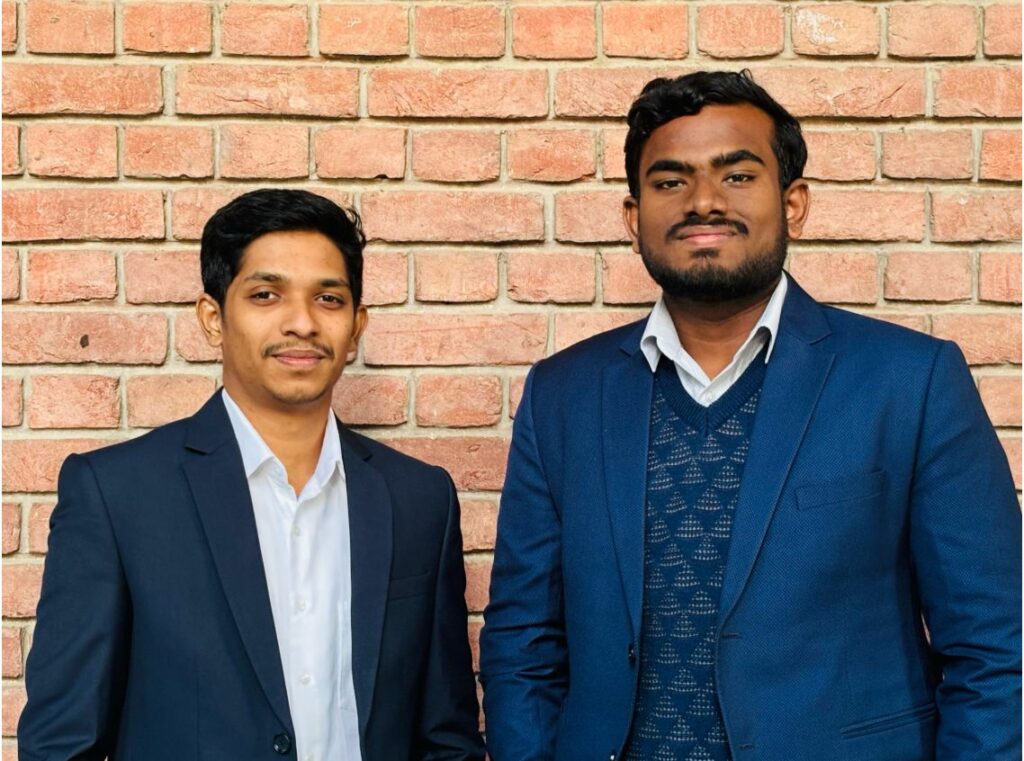
When we first met Hari and Rogith, Dream Aerospace felt less like a startup and more like a lab that had turned into a company by force of conviction. Their journey started at IIT Kanpur, with a list of questions no one seemed to be answering thoroughly enough.

During 247VC’s team visit, the discipline around the hot-fire rig struck us. The founders had cycled components to roughly twice the spec, and run simulations far past nominal envelopes, mapping where things break before any customer asked. That is the difference between a team chasing a milestone and a team building toward flight heritage.

The honest risk we underwrote is flight heritage itself. Until a system flies, every claim carries an asterisk. However, perhaps risk mitigation should be learnt from founders building for Orbits, they’ve never set foot in. 

Where existing technologies fall short

Satellite propulsion has effectively been stuck on the same trade off curve for 30-40 years. 

  • Chemical propulsion: huge thrust, low specific impulse, messy integration and toxic legacy propellants. 
  • Electric propulsion: ambitious specific impulse and tiny fuel consumption, but very low thrust and bulky hardware that sprawls across the satellite bus. 

Most systems fix those numbers in hardware, which locks vendors into niche missions and forces an 18 month re-engineering cycle every time a new customer arrives.

Then there is the uncomfortable reality of propellants. Hydrazine is still the performance benchmark, but it is one of the most toxic substances flown in space. Green alternatives like hydroxyl ammonium nitrate are improving, yet they have taken NASA, AFRL and Ball a decade-long programme and a nationwide team to mature from lab chemistry to a flight-proven system. 

Dream Aerospace Inside India’s Space Stack

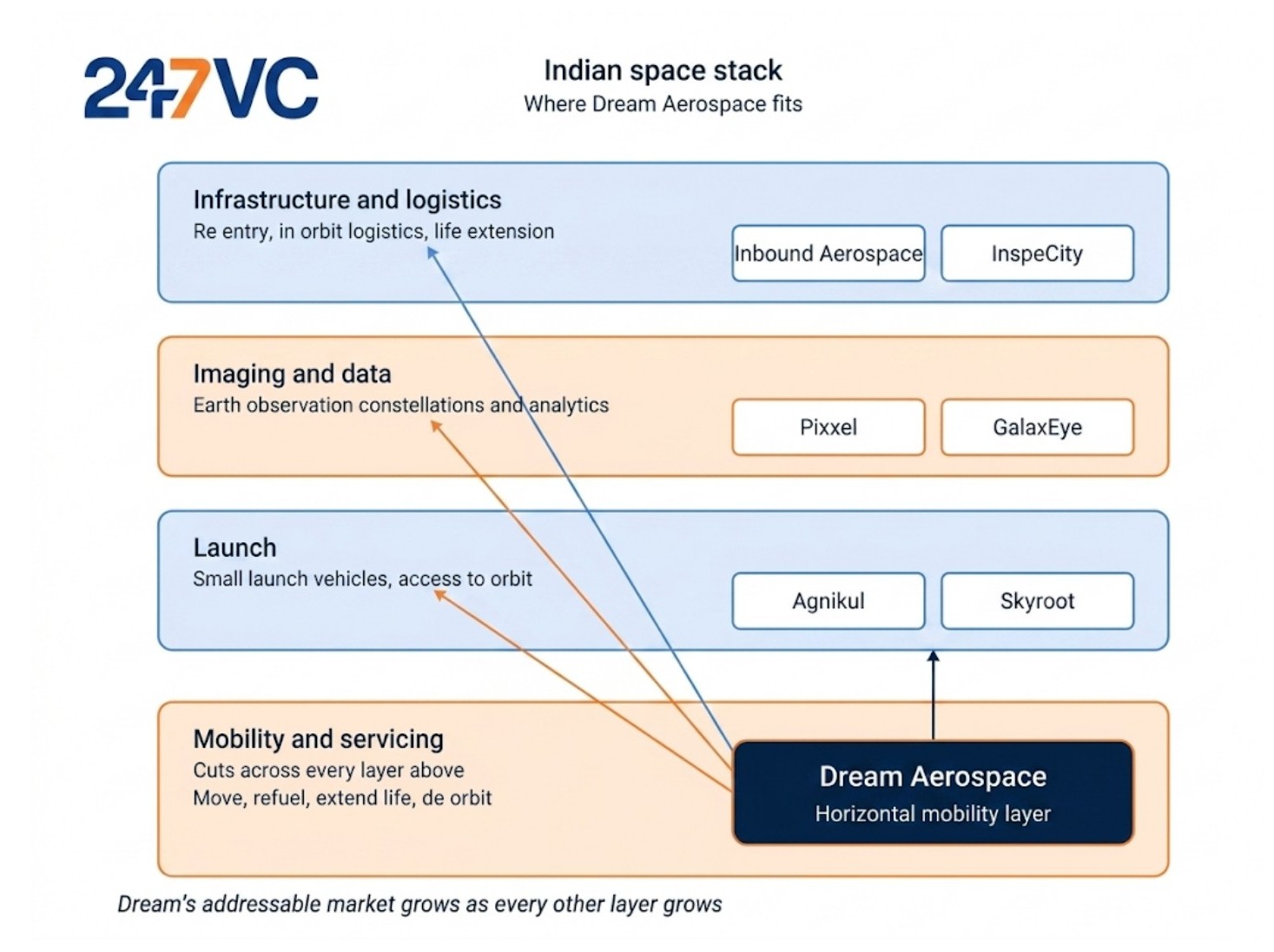
To really understand Dream’s place, it helps to visualise the Indian space stack as layers.

The Indian space stack is seeing problem solvers across launch, payload, data, infrastructure and logistics. Cutting across all of these is a need for mobility, refueling and servicing.

Dream sits squarely in that horizontal layer: moving cargo between orbits and toward cislunar space, keeping them alive longer, de-orbiting them cleanly. Its addressable market grows every time the rest of the stack grows.

247VC’s SpaceTech thesis rests on four core bets:
  1. Unit Economics: Propulsion will be valued for cost efficiency and integration simplicity, reshaping satellite business models.
  2. Recurring Infrastructure: In-space refueling and servicing will evolve into catalog services and standardized SLAs, moving away from bespoke projects.
  3. India as Infrastructure Provider: Indian engineering and cost discipline will enable the country to build foundational layers that other nations can leverage.
  4. Lab-Grown Founders: Deep tech success will come from founders embedded in technical challenges, capable of navigating both physics and regulatory landscapes.

Our investment decision is driven by timing (propulsion moving from concept to real missions), geography (India’s unique advantages), and the founders’ technical and financial discipline. 247VC believes the future of satellite operations will shift from propellant metrics to mobility and servicing contracts, transforming propulsion from a subsystem to a utility. Dream’s orthogonal approach to green chemistry and mission-flexible architecture positions it to lead the next wave of space mobility solutions. 

As our SpaceTech thesis has matured, 247VC has marked its first investment enabling Dream Aerospace’s Earth to Orbit journey and we wish legendary founders like Hari and Rogith best of luck for their journey ahead!